
Skip to content

This site is intended for UK healthcare professionals only. If you are not a UK healthcare professional, please visit our dedicated site for more information at beonemedicines.co.uk

NICE recommends BRUKINSA as an option for treating adult patients with WM who have had at least one treatment, only if BR is also suitable.3

It is only recommended if the company provides it according to the commercial arrangement.3

BRUKINSA monotherapy is accepted by SMC as an option for treating WM in adults who have received at least one prior therapy, or in first-line treatment for patients unsuitable for chemo-immunotherapy.4

This advice applies only in the context of an approved NHSScotland Patient Access Scheme (PAS) arrangement delivering the cost-effectiveness results upon which the decision was based, or a PAS/ list price that is equivalent or lower.4
ASPEN was the first and only head-to-head BTKi trial in WM, with up to 6 years follow-up5–10

Waldenström’s macroglobulinaemia

Primary endpoint: CR+VGPR rate with BRUKINSA vs ibrutinib in patients with MYD88  mutation5

28%

BRUKINSA

(n=29/102)

VS

19%

ibrutinib

(n=19/99)

There were no CRs in either treatment arm5

While the primary endpoint of superiority did not reach statistical significance (p=0.09), numerically higher VGPR rates were achieved in the BRUKINSA treatment arm at a median follow-up of 19.4 months5

Numerically higher VGPR and MRR rates vs ibrutinib at extended follow-up6

Median follow-up 44.4 months; patients with MYD88 mutation

VGPR

36%

BRUKINSA

(n=37/102)

VS

25%

ibrutinib

(n=25/99)

MRR

81%

BRUKINSA

VS

80%

ibrutinib

Median follow-up: 44.4 months; patients with MYD88 mutation

VGPR/CR in TN patients

37%

BRUKINSA

(n=7/19)

VS

22%

ibrutinib

(n=4/18)

VGPR/CR in patients with 1–3 lines prior therapy

37%

BRUKINSA

(n=28/76)

VS

26%

ibrutinib

(n=19/74)

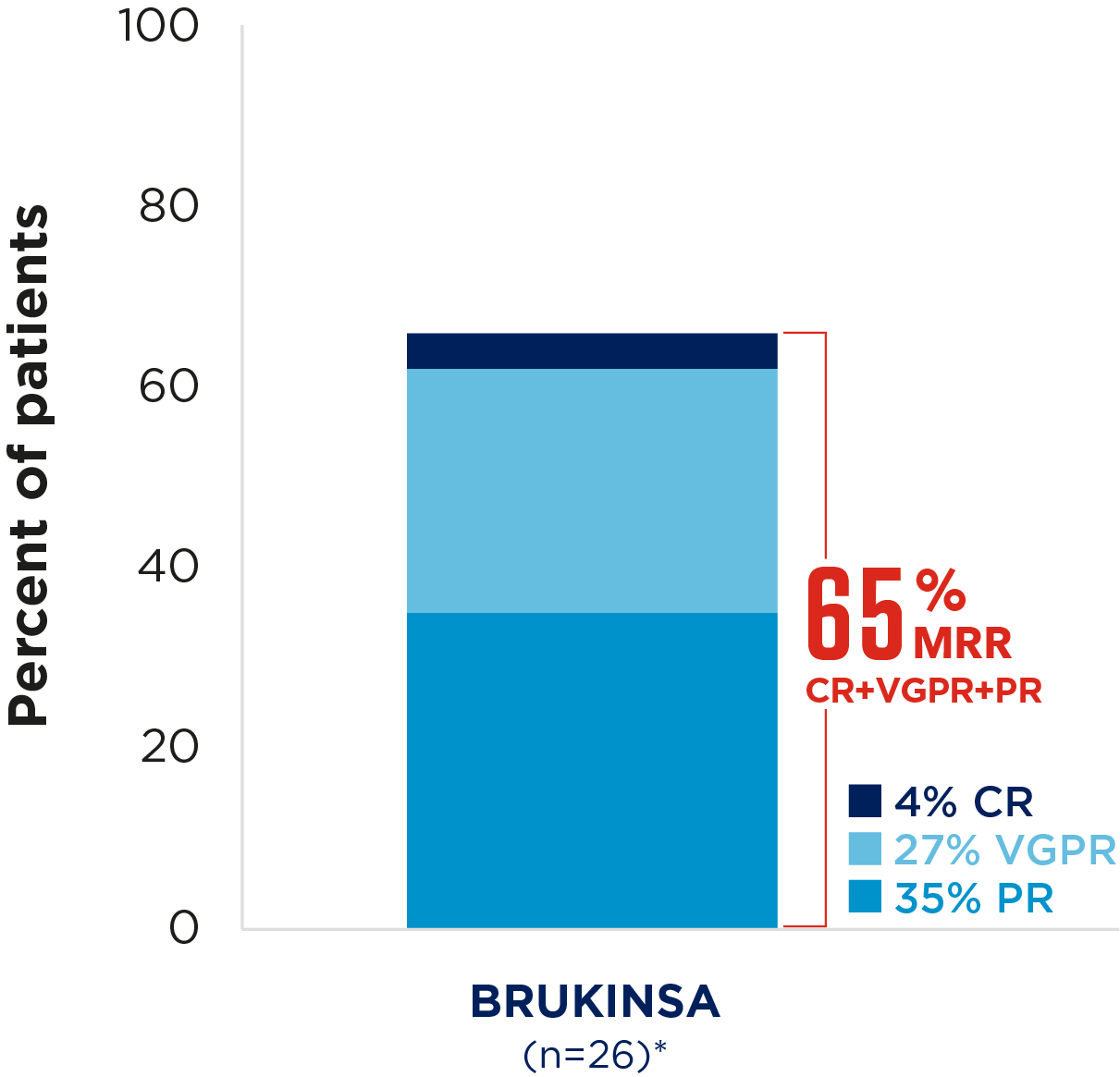
Secondary endpoint: Responses in patients with MYD88  wild type6

Investigator-assessed; median follow-up: 42.9 months

Adapted from Dimopoulos, et al. 2023.6

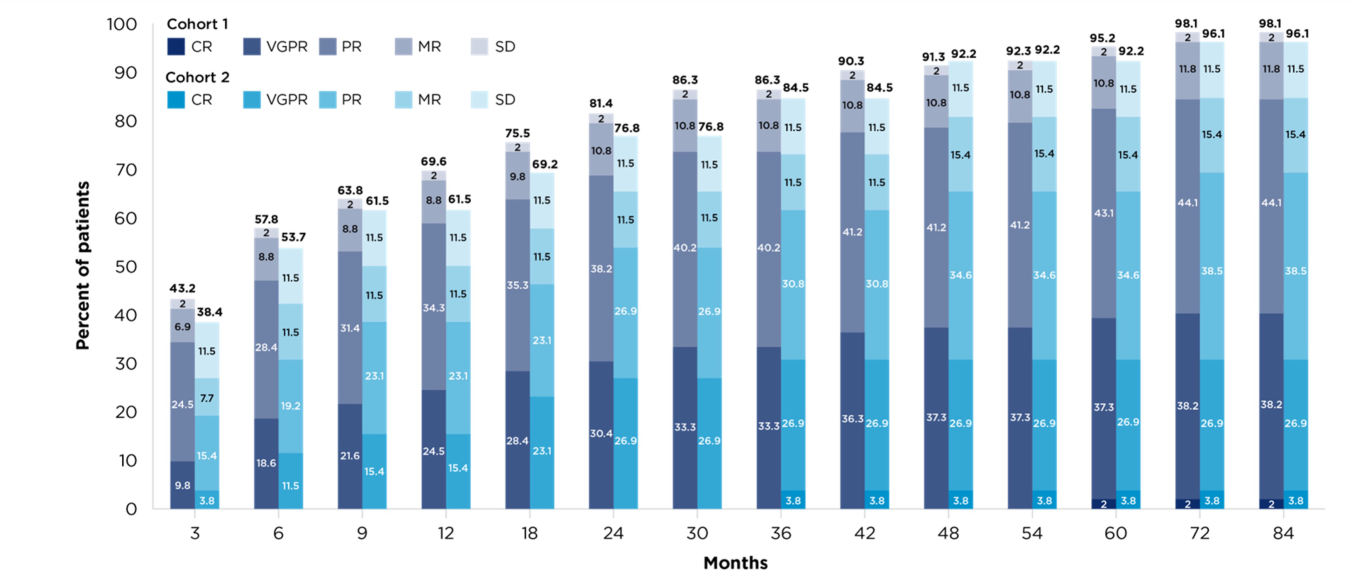
Best overall response rates in patients with WM receiving BRUKINSA10

Cohort 1: patients with MYD88 mutation, n=102; Cohort 2: patients with MYD88 wild type, n=28; median follow-up 69.8 months

Adapted from D'Sa, et al. 2024.10

Scroll left and right to see more

Significantly fewer GI symptoms were reported at the start of treatment with BRUKINSA than with ibrutinib

Cycle 4; (N=201)

Diarrhoea: p=0.01
Nausea/vomiting: p=0.01

Among patients achieving a VGPR, patient-reported outcomes at 6 months showed a greater improvement with BRUKINSA than with ibrutinib

Cycle 25; (n=48)

Fatigue: p=0.0220
Physical functioning: p=0.0476

Any-grade; patients with >36 months follow-up

4%

BRUKINSA

(n=72)

VS

17%

ibrutinib

(n=64)

Treatment discontinuations due to AEs

9%

BRUKINSA

(n=9/101)

VS

20%

ibrutinib

(n=20/98)

Dose reductions due to AEs

16%

BRUKINSA

(n=16/101)

VS

27%

ibrutinib

(n=26/98)